


Who Gets the Keys? Why Role-Based Access Control Matters for IoT Fleets

Who Gets the Keys? Why Role-Based Access Control Matters for IoT Fleets
IoT has grown up. What began as a handful of pilot devices on a lab bench is now thousands of SIMs, sensors, and gateways spread across warehouses, vehicles, and job sites — all connected, all generating data, and all needing to be managed by someone. But “someone” is rarely one person anymore. It's a team: network engineers, finance analysts, regional operations leads, support agents, sometimes outside contractors. And every one of them needs a different level of access to the platform running the show.
That's the problem Compass, SIMPL's IoT management platform, was built to solve — and it's also exactly why we've been rolling out role-based access control (RBAC) across the platform. Before we get into RBAC, though, it's worth a quick refresher on what Compass actually is.
What is Compass?
Compass is SIMPL's unified dashboard for managing IoT connectivity — SIMs, eSIMs, and EverSIM profiles — across multiple carriers, all from one screen. If you're managing a fleet of connected devices, you already know the pain: one carrier's portal for your U.S. devices, another for European ones, a spreadsheet holding it all together, and a support ticket every time something goes sideways. Compass normalizes data from major carrier platforms like Jasper, ThingSpace, Netcracker, and GDSP, so instead of juggling logins, you get one view of your entire connected fleet.
From that single dashboard, IoT managers can activate, suspend, or swap device profiles instantly, set up automatic failover so a dead connection doesn't mean a dead device, and catch usage anomalies before they turn into a five-figure surprise on next month's bill. Compass works with SIMPL's own connectivity or with carriers you already have — what we call Bring Your Own Carrier — so adopting it doesn't mean ripping out what already works.
What makes this genuinely different from most IoT platforms on the market is that Compass doesn't ask you to pick a carrier and live with it. It sits above the carrier layer entirely, giving IoT managers the flexibility to route around network issues, negotiate on their own terms, and scale from a pilot fleet to millions of devices without switching tools.
The Problem with One-Size-Fits-All Access
Here's where it gets interesting — and where a lot of IoT platforms quietly fall short. A dashboard that manages your entire connected fleet is powerful. It's also a single point of failure if everyone who touches it has the same level of access.
Think about who actually needs to be in a platform like Compass on any given day. A network operations engineer might need to suspend a misbehaving device and reroute its traffic. A finance lead just wants to see the monthly spend by region, not the ability to deactivate a thousand SIMs. A contractor onboarding new hardware in the field needs to activate a device — nothing more. Give all four people admin-level access, and you haven't made the platform more useful. You've made it more dangerous.
This is exactly the gap that role-based access control closes.
What is RBAC?
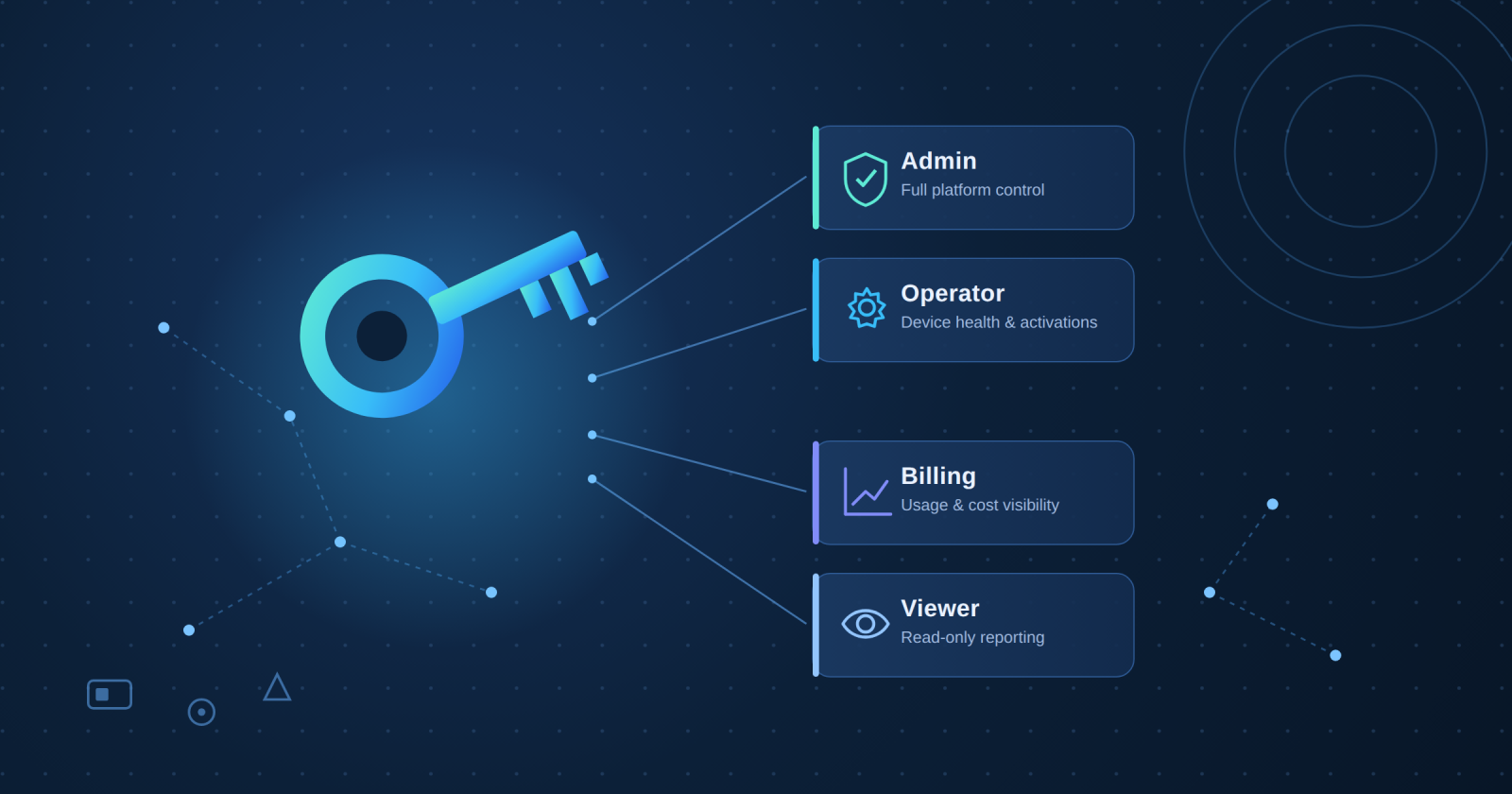
Role-based access control (RBAC) is a security model that determines what a user can see and do inside a system based on the role they're assigned — not their individual identity. Instead of granting permissions one person at a time, an administrator defines roles like Admin, Operator, Billing, and Viewer, each with a specific set of permissions, and then assigns people to those roles.
An Admin might have full control: activating devices, managing billing, inviting new users, configuring failover rules. An Operator can manage day-to-day device health — activations, suspensions, troubleshooting — without touching billing or user management. A Billing role sees usage and cost data but can't so much as suspend a SIM. A Viewer gets read-only visibility, ideal for a stakeholder who just needs the numbers for a report.
The logic is simple: access should match responsibility, not convenience.
Why RBAC Is a Big Deal for IoT Platforms
It's tempting to think of access control as a back-office detail — necessary, but not exactly exciting. In IoT device management, though, RBAC earns its keep in three distinct ways.
Security. IoT fleets are attractive targets precisely because they're distributed and often under-monitored. A single overprivileged login — a shared password, a departed employee's account that never got revoked, a contractor's credentials — can become the weak link that takes down or exposes an entire fleet. RBAC limits the blast radius. If a Viewer account is compromised, the intruder gets a dashboard, not the ability to deactivate your fleet. This principle, often called least privilege, is one of the most effective and least glamorous ways to reduce risk in any connected system.
Usability. Access control isn't just about keeping people out — it's about making the platform easier to use for everyone who's supposed to be in it. When an Operator opens Compass and sees only the tools relevant to their job, they're not wading through billing configuration screens or user management settings to find the device toggle they actually need. A focused view is a faster, less error-prone one. Fewer clicks, fewer wrong buttons, fewer 2 a.m. mistakes.
Flexibility. As an IoT deployment scales, the team managing it changes shape. New hires join, contractors rotate through, departments that never used to touch the platform suddenly need visibility into it. RBAC lets IoT managers adapt access on the fly — assign a new Operator in seconds, grant a finance team temporary Viewer access during a budget review, revoke a contractor's login the moment their project ends — without rebuilding permissions from scratch every time the org chart shifts.
Bringing RBAC to Compass
For a platform like Compass, which already sits at the center of multi-carrier, multi-region, potentially multi-million-device operations, role-based access control isn't a nice-to-have bolt-on. It's a natural extension of what the platform is already trying to do: turn IoT complexity into something a team can manage confidently, together.
As Compass rolls out its RBAC capabilities, IoT managers get more than a new settings menu. They get a platform where the right people have exactly the access they need — no more, no less — and where growing the team doesn't mean growing the risk.
IoT has grown up. It's about time the tools managing it grew up with it.
 The Future of IoT: 5G and Beyond